Month: August 2018
Cloud HCM and Momentum
Last week I wrote a blog entry suggesting that the any perceived advantage Workday had over Oracle HCM Cloud in the past has now been eroded as Oracle has caught up (and possibly overtaken) in the areas where Workday previously held an advantage.
I then wrote a blog post talking about the momentum a vendor may have and demonstrated it on a merged version of the Magic Quadrant. It’s fallen foul of Gartner’s policies and they’ve asked me to remove certain pieces, as they’re well within their rights to do.
As a result:
- I cannot amend the Magic Quadrant to show historical comparisons
- I cannot link to the Gartner article
- I cannot use Gartner’s conclusions to make a point
The current and last couple of years HCM Magic Quadrants can be found online in many places, such as here.
If you had to place your company’s investment on which Cloud HCM vendor would have the lead in a few years’ time, where would your money be?
Cloud HCM and the Turning of the Tide
The ‘big 3’ of the Cloud HCM world are SAP/SuccessFactors, Workday and Oracle HCM Cloud. Each of the suites has its respective strengths and weaknesses, and situations in which it’s most likely to win in customer head-to-head battles. Being a keen watcher of the ecosystem I’m starting to wonder whether the status-quo might be changing however. Here’s why …
Ignoring SuccessFactors for a moment, let’s focus on Workday and Oracle HCM Cloud.
Historically, if it’s a Workday win it’ll often be down to:
- User Experience,
- Workday’s image in the marketplace (strong marketing, focus on customer happiness), or
- the way that they’ve demoed to the customer (a focus on convincing HR, and/or a superior pre-sales experience).
If it’s an Oracle win, it’ll often be down to:
- Breadth of suite (a wider choice of modules covering more of what the business needs)
- Depth of functionality (sheer number of localisations, and many Oracle modules are more ‘complete’, e.g. benefits, recruiting, learning)
- the way that they’ve demoed to the customer (they’ve sold to the business as a whole, not just HR so other factors come in to play – such as integration, extensibility or the strength of ERP Cloud)
As someone who pays the bills consulting on Oracle HCM Cloud I’m clearly not impartial however I am starting to see signs that the scenarios listed above where Workday has the edge are starting to be reduced. Let’s take them one at a time …
User Experience
Oracle HCM Cloud’s User Experience has taken a huge leap forward in the last 12 months. The new responsive/newsfeed UI is a big step forwards on both desktop and mobile.
Let’s compare the two’s most recent versions:
Oracle HCM Cloud (as of Aug 2018)
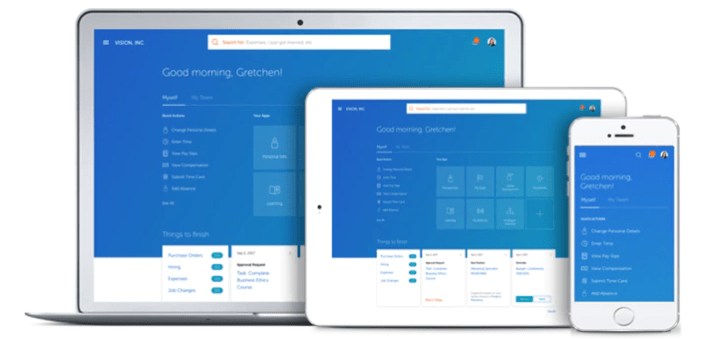
Workday ‘Canvas’ UI (as of WD31 later this year)

I’m not saying any one of the above is better than the other – in fact, both are great looking systems compared to what we had not so long ago – but I don’t think Workday has the UX advantage that it once had.
Workday’s Image in the Marketplace
Everyone loves Dave Duffield (although I doubt he’s on Larry’s Christmas card list) and Workday as a company has certainly managed to garner a very positive image in the marketplace. There are starting to be signs that this is changing however.
Lawsuit
We’ve heard of the recent lawsuit where Workday is being sued (together with the SI) by Sacramento City Unified which says it didn’t deliver on a $5.2 million implementation, claiming “for approximately two years the project flailed, then ultimately failed. While Workday and Sierra-Cedar got paid, in the end, they put the district right back where it started with nothing to show after over two years. “
Industry thought leaders
Some high-profile HR luminaries are starting to question whether the accolades are justified:
Matt Charney (Editor-in-chief for Recruiting Daily, named a “Top Recruiting Influencer” by Huffington Post, Glassdoor, LinkedIn and Forbes, plus frequent HR public speaker)
‘When is Workday going to admit (in public) that their “ATS” product is vaporware? Someone really should file a class action against $WDAY.’
William Tincup (HR Technology writer, speaker, advisor, consultant, investor, storyteller & teacher. He’s a contributor to Fistful of Talent, Human Capital Institute, Human Capitalist, HRTechEurope, LinkedIn Talent Blog, and HRExaminer and also co-hosts a daily HR podcast called DriveThruHR.)
“Workday’s tagline “Built For the Future” is a wonderful twist on dramatic foreshadowing. Future, as in, you might actually receive usable software at some point in the future. For all the Workday apologists, I’m not attacking the brand nor the people that happen to work for Workday but if you are the darling of our industry you might want to consider releasing best of breed products rather than what you’ve released in recruiting, onboarding, compensation, and learning. ‘
Source (the comments thread on this article is also pretty enlightening)
Social Media
Here is a selection of complaints on Twitter:


It’s clear that while the decision-makers higher up in the companies themselves might be pro-Workday, those who use the product on a daily basis sometimes have a different opinion.

Summary
So, is the tide turning yet? Are the advantages that Workday had (the UI and the positive reputation) starting to be eroded? Time will tell, but this could be the start of a change.
 Fusion Tipster